For almost two decades, Richard Lampert left the Stuttgart studio of his long-time partner, the painter Sabine Reuter, untouched. For her widower, confronting the work she had left behind was simply too painful. Now, though, the time had come – and Lampert suddenly had time, too. In 2023, after 30 years, he sold his eponymous furniture company, whose collection includes designs by Egon Eiermann, Herbert Hirche and Ernst Moeckl alongside those of contemporary designers such as Tilla Goldberg, Marco Dessí and Steffen Kehrle. The brand continues without the man whose name it bears. Since stepping back three years ago, Lampert has found a second home in Vienna, dividing his time between the Austrian capital and Stuttgart.
To explore Reuter’s long-undisturbed artistic legacy, Lampert joined forces with Max Dax. The writer and former editor in-chief of the music and culture magazine Spex had curated “Hyper! A Journey into Art and Music” at Hamburg’s Deichtorhallen in 2019. This time, he was invited to curate an exhibition of Reuter’s work at the Christine König Gallery as part of Vienna’s “curated by” programme.
Dax says he accepted because, on his very first visit to the studio, he was overcome by a feeling for which Portuguese has a beautiful word: saudade. Often heard in the country’s fado tradition, the word is usually translated as “longing”. Dax offers another rendering: “the presence of an absence”. “I spent an entire afternoon in the orderly chaos of Sabine Reuter’s studio, pulling painting after painting out of storage, opening photo albums and plan chests filled with drawings. I saw unfinished paintings and the untouched raw materials from which she had built her pictures: paints, varnishes, plaster casts, newspaper cuttings. A universe of gestures and proportions opened up before me, a conception of painting that seemed to rest on poetic metre and musical rhythm.”
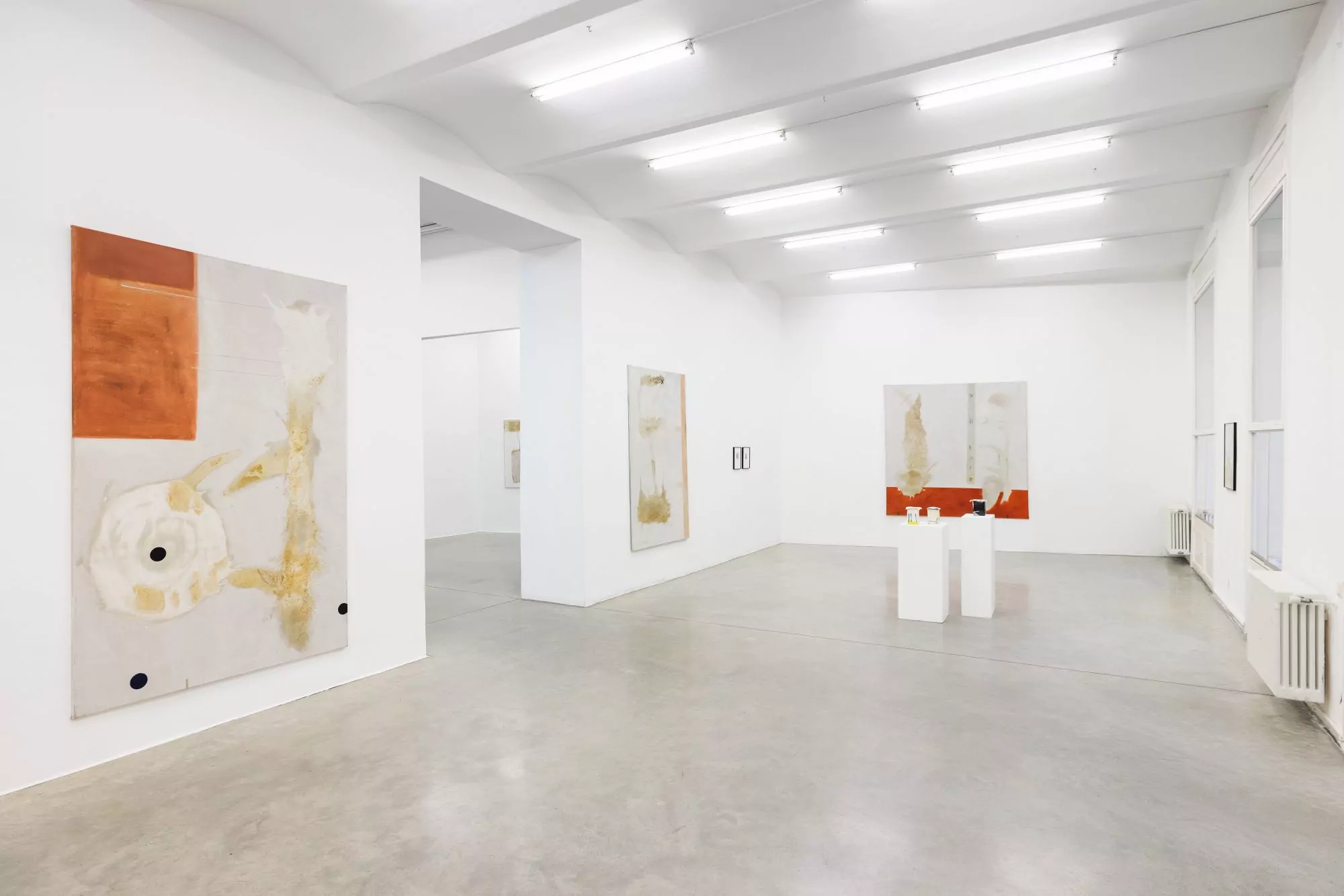
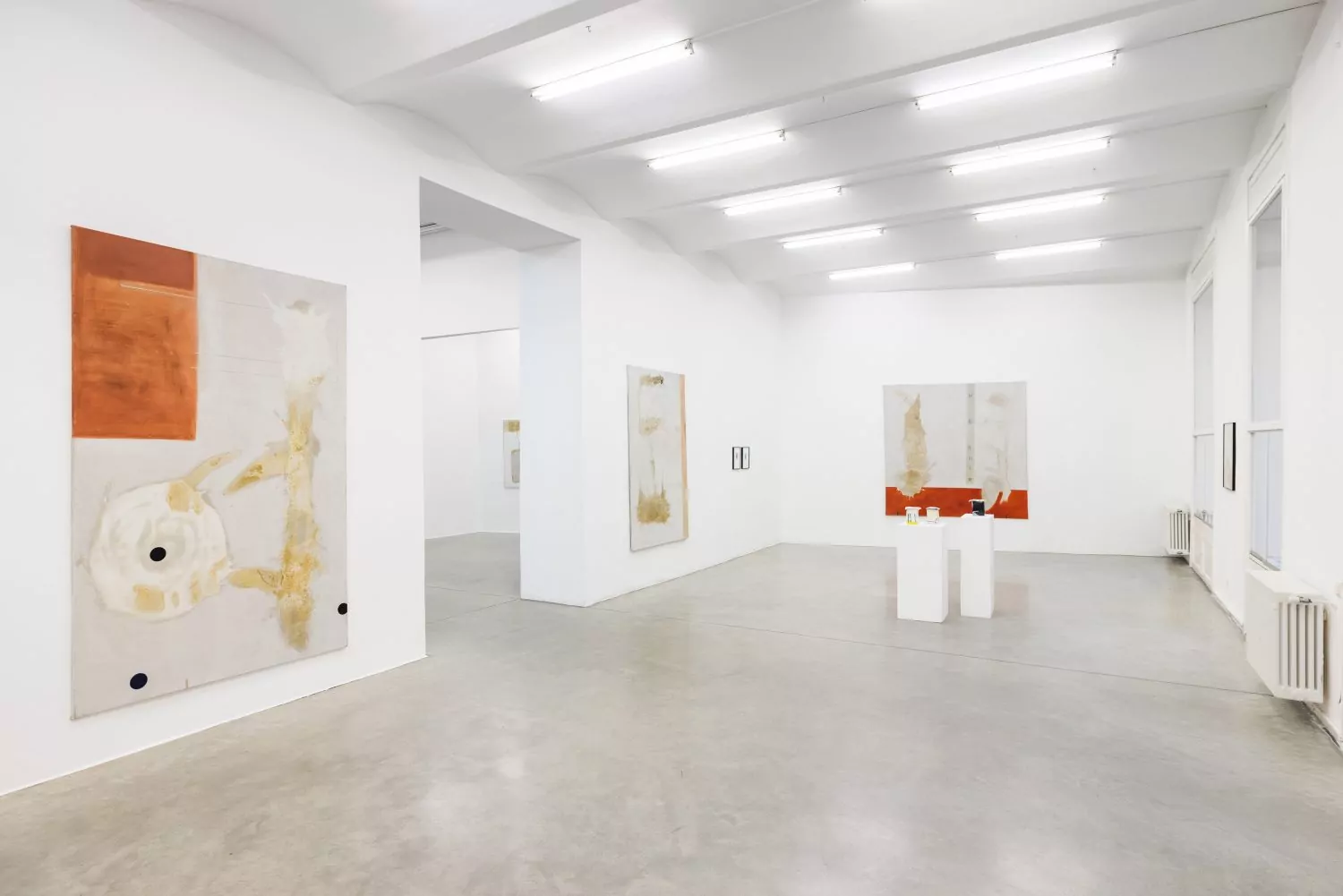
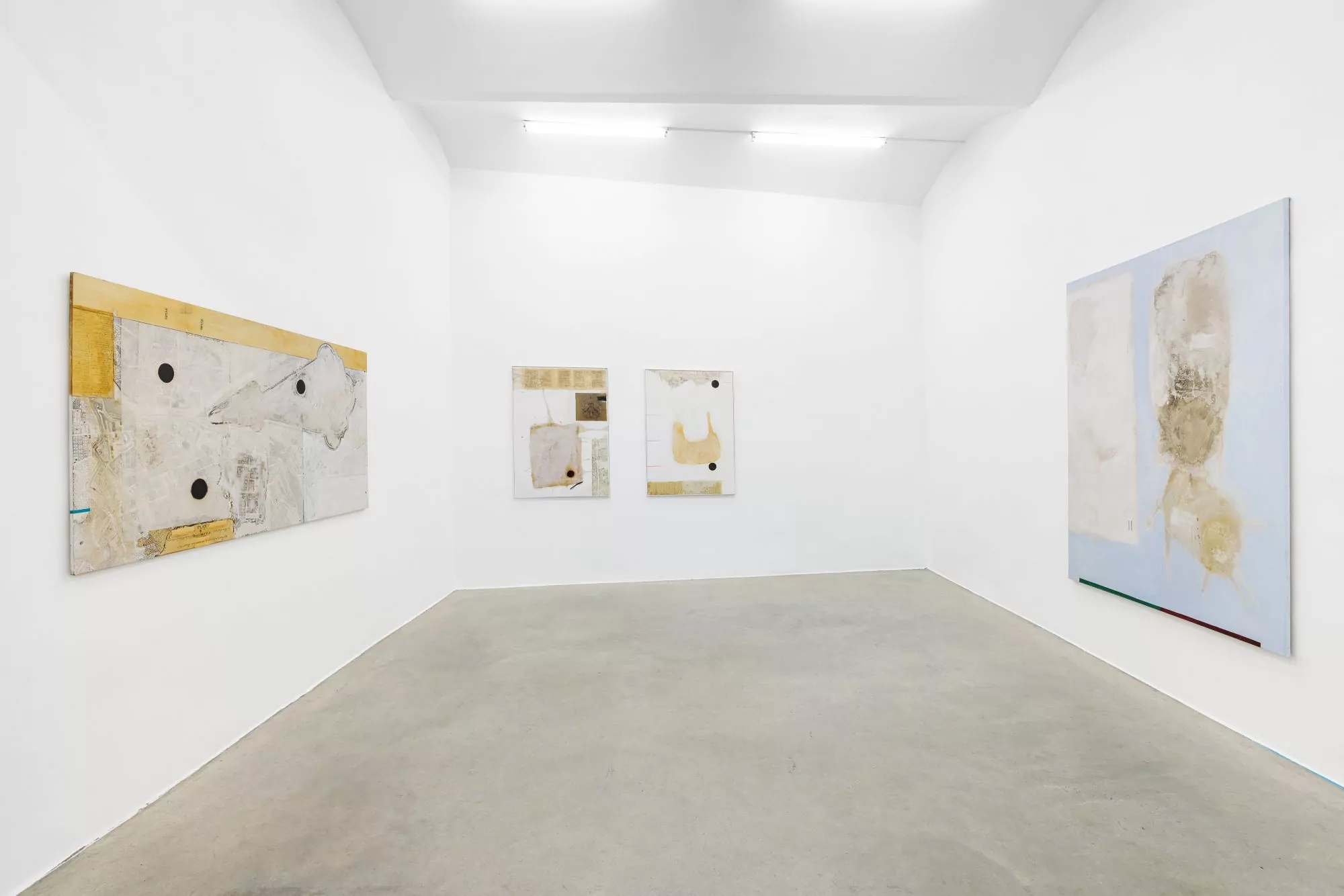
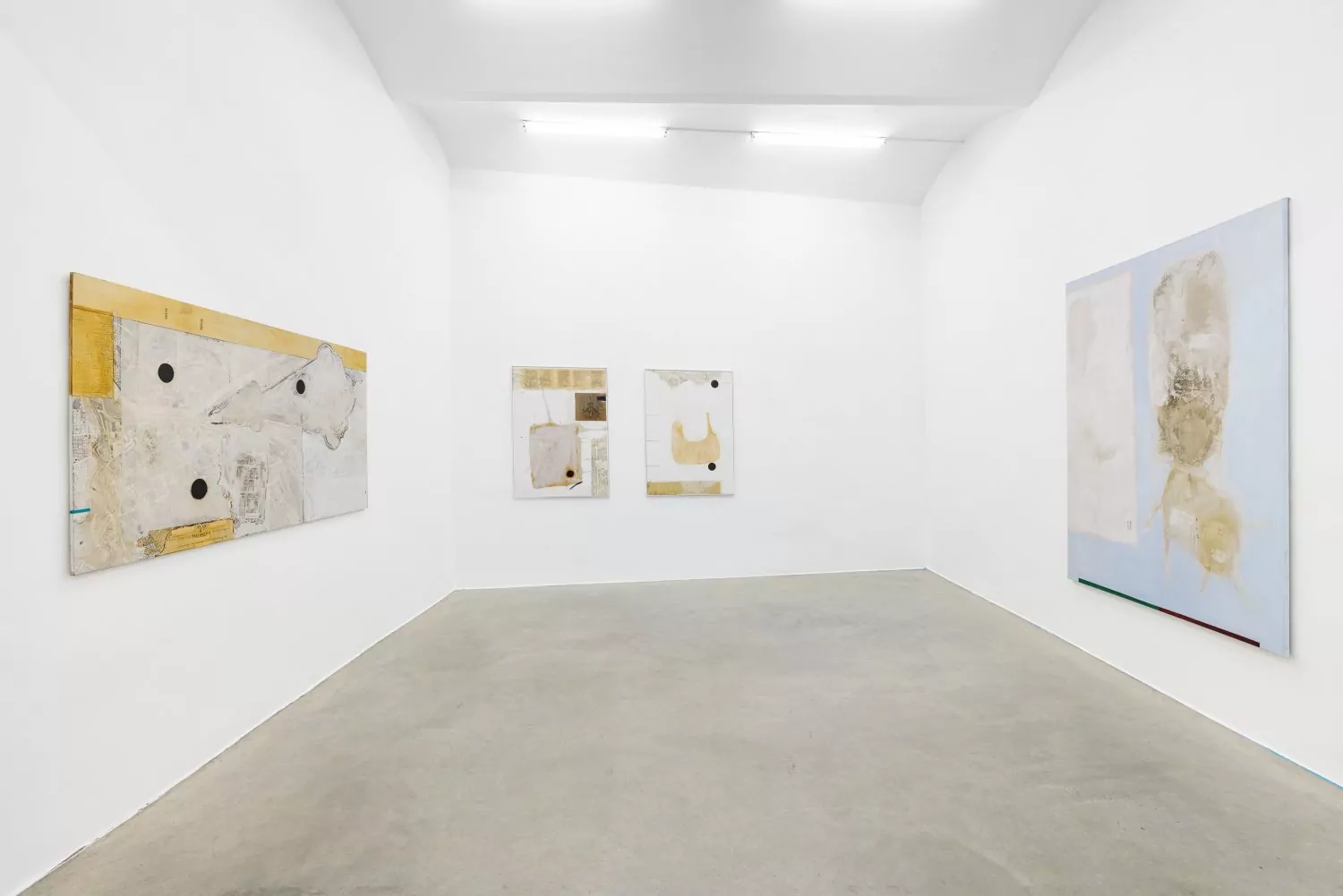
From the estate of Reuter, who died in 2005 aged just 51, Dax selected some 30 works for the exhibition now on view at the Christine König Gallery in Vienna. Its title: “Presence of an Absence”. The exhibition presents itself less as an attempt to assign Reuter a retrospective place in art history than as “a fresh encounter with a body of work, long absent from public view, that seems remarkably to have anticipated our own moment”.
An 80-page book, edited by Dax and Lampert and featuring photographs of the studio alongside numerous reproductions of Reuter’s work, accompanies the exhibition, which runs until 14 November.
Peter-Philipp Schmitt, October 2026 in FAZ Magazin

»Das Bild sagt mir also sich selbst«


»…Let’s start from the beginning—back with the punk-inspired “Grande Dame,” Christine König. She’s not only exhibiting works by Erik Swars, Joseph Kosuth, and the Ukrainian charcoal artist Nikita Kadan, but also by Sabine Reuter. The show in König’s main gallery was curated by the jack-of-all-trades Max Dax. And since I just mentioned the precise rhythm in Vienna, what that means is exemplified in Sabine Reuter’s collage-style painting. More specifically: in her delicate yet breathtaking brushstrokes.
Essential, magnificent rediscoveries
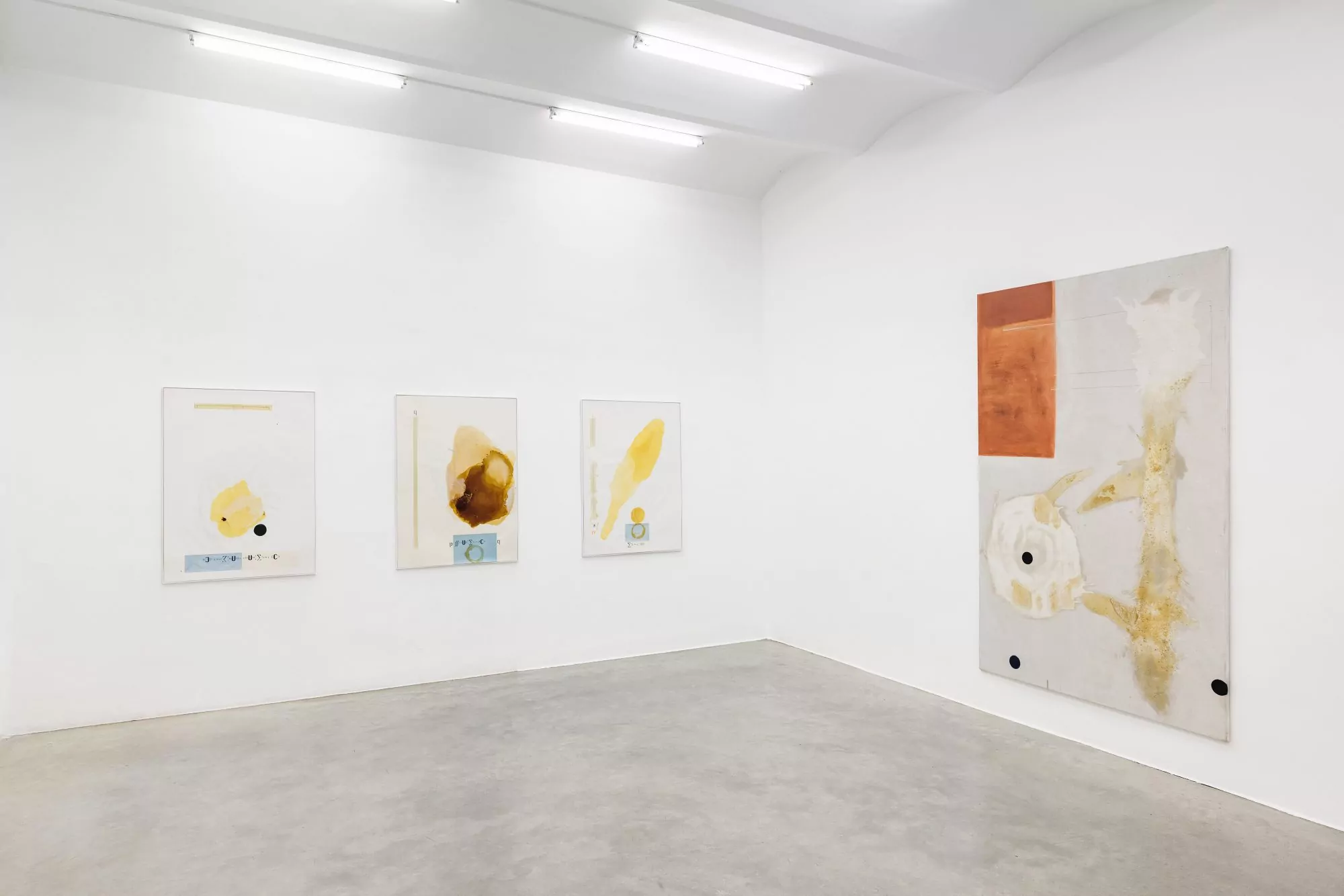
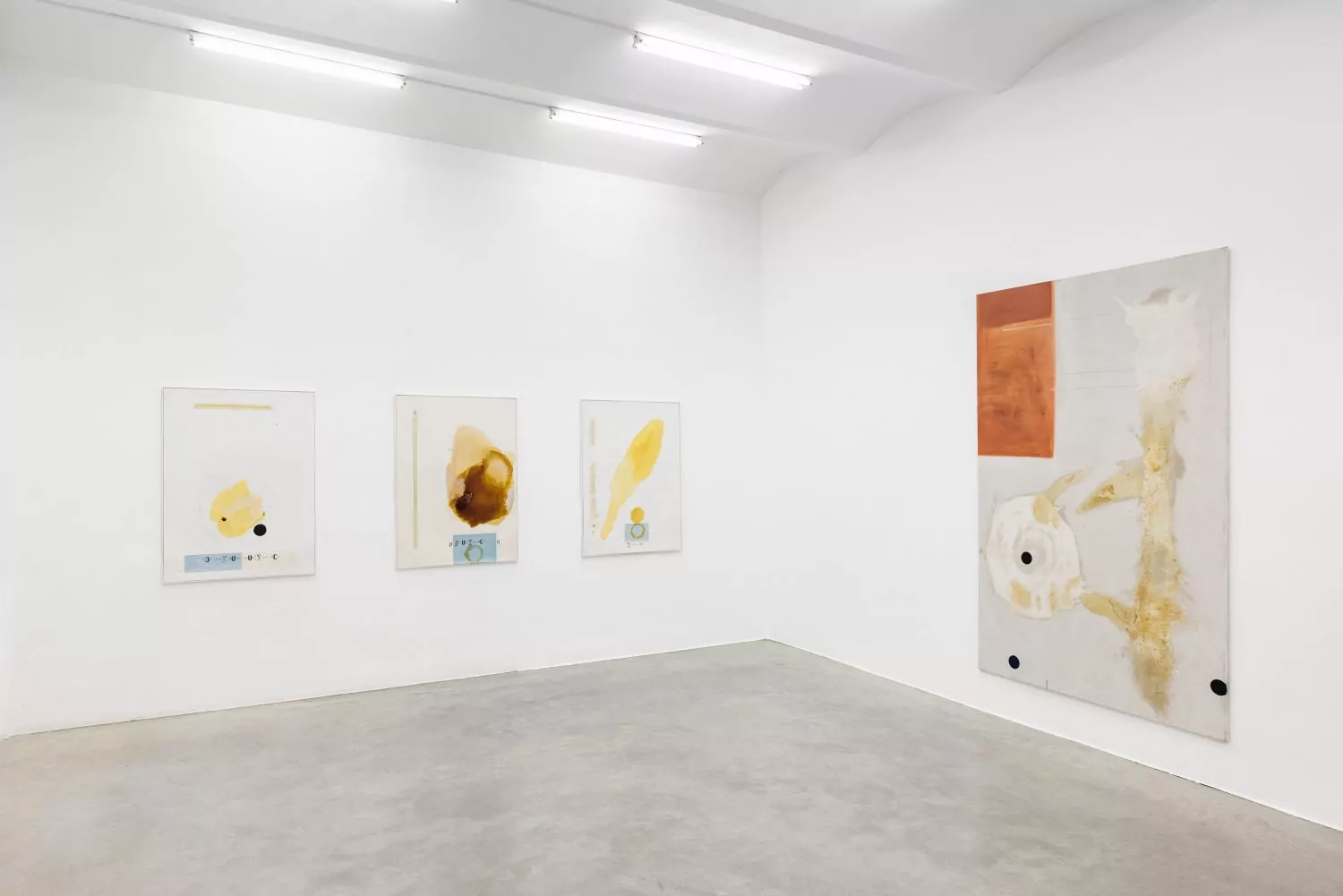
Mysterious systems of symbols transform her canvases into a surreal backdrop. Old, yellowed city maps and television images from the early 2000s appear here, luring the viewer into an intricately composed labyrinth of associative images from which it’s almost impossible to escape. Reuter’s painting is mesmerizing—and it achieves this through formal precision, not through immersive spectacle.
The artist passed away in 2005, at the age of just 51. Her exhibition “Presence of an Absence” is, so to speak, a long-overdue rediscovery…«
Jonathan Guggenberger, 16.09.2026 in Monopol Magazin


Presence of an Absence
11.9.–14.11.2026
curated by Max Dax
Christine König Galerie Wien
Schleifmühlgasse 1A
1040 Wien




»Ein roter Fleck sieht anders aus, als einer der nicht rot ist«


l’amour
die tür
the chair
der bauch
le tür
d’amour
der chair
the bauch
le chair
der tür
die bauch
th’amour


Christine König Galerie (Vienna) is delighted to announce Presence of an Absence, an exhibition of works by the painter Sabine Reuter, who died in 2005, curated by Max Dax as part of curated by (11 September–14 November 2026).
Presence of an Absence brings back into public view a body of drawings and paintings that has remained almost entirely preserved for more than two decades—and whose singular sense of presence emerges all the more clearly today.
Sabine Reuter died in 2005 at the age of just 51. She left behind more than a thousand drawings and paintings, as well as an almost completely preserved studio in Stuttgart, which, thanks to the dedication of her partner Richard Lampert, has remained untouched since her death.
To enter this studio today is to encounter the presence of an absence. Books, photo albums and plan chests, paints, varnishes and plaster casts, newspaper clippings, found objects and the raw materials of her painting have all remained. In Portuguese, there is a word for such an experience: saudade—the presence of an absence. This “presence of an absence” forms the point of departure for the exhibition.
Reuter was an artist of condensation. Her painting emerged from a way of thinking that made no separation between literature, poetry, music, philosophy, mathematics and the observation of everyday life. She read Gertrude Stein, Ernst Jandl, Thomas Bernhard, Elfriede Jelinek, Robert Musil, Ingeborg Bachmann and Paul Celan; Ludwig Wittgenstein became an important point of reference. From her engagement with language, she adopted not so much statements as methods: compression, repetition, rupture, displacement and omission. What might be a syllable in a poem or a symbol in a formula becomes, in her work, colour, surface, material and trace.
Her paintings are therefore not illustrations of ideas. They are movements of thought—and at the same time are sustained by a pronounced sense of rhythm. Divisions of space, proportions and sequences of colour can at times seem like visual metres. The invisible pulse of music and the rhythm of concrete poetry find their counterparts in her painting without ever allowing themselves to be translated into unequivocal meanings.
Letters, numbers, dates, fragments of text, newspaper clippings, city maps and mathematical formulae encounter plaster, sand, shellac and pigments she mixed herself.
At the same time, her works maintain a remarkable balance between precision and openness. Layer rests upon layer; the painting over of what lies beneath becomes an elemental part of the image, remaining present as trace, intimation or resistance. In this sense, Sabine Reuter’s paintings are palimpsests: they preserve the history of their own making without revealing it.
“Das Bild sagt mir also sich selbst” (“The picture thus tells me itself”) is one of her opaque formulations, borrowed from literature. It points to an essential quality of her work: the picture need not mean anything other than itself in order to be something. It can pose questions, release associations and unsettle habitual ways of seeing.
Perhaps this is precisely why her works do not feel like historical artefacts today. Her engagement with fragments and superimpositions, with language, material, shards of information and open systems of meaning resonates with a present in which reality itself increasingly seems to consist of excerpts, signs, data and images layered one upon another.
Presence of an Absence should therefore be understood less as a retrospective art-historical classification of Sabine Reuter’s work than as a fresh encounter with an oeuvre that had long disappeared from public view—and which, with surprising prescience, seems to anticipate the conditions of our own time.
Accompanying the exhibition is an 80-page book edited by Max Dax and Richard Lampert, featuring an extended oral history, views of the studio and numerous reproductions of Reuter’s works.
(Text: Max Dax, 2026)